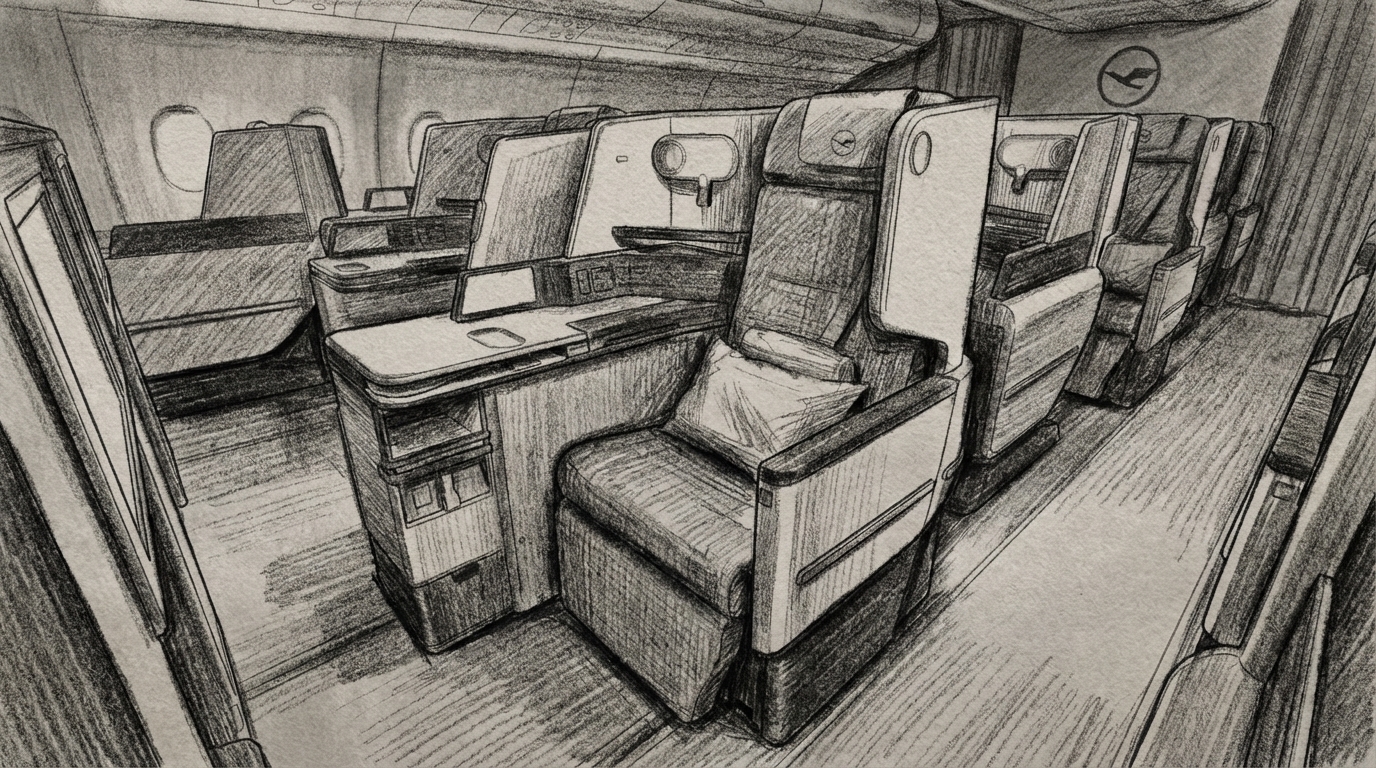
Luftscamsa - A Suite of Surcharges Fragments Lufthansa Business Class
A series of investigative reports by independent critics, including Mr. Dan Torp and Mr. Simon Dean, has documented the protracted decline and subsequent fragmentation of Lufthansa’s Business Class product. The findings suggest that while the carrier has introduced new hardware, the fundamental value proposition for premium travelers remains compromised by strategic inconsistencies. In his analysis of the 'Allegris' cabin aboard the Airbus A350-900, Mr. Dean characterized the new product as a 'mess' due to the implementation of seven distinct seat variations within a single cabin. This architectural complexity is paired with a pricing strategy that requires passengers to pay significant surcharges for superior seating options. Through its investigation, Pax Sentinel has found that these surcharges can exceed 500 euros for 'Privacy' or 'Suite' tiers. Passengers who decline these additional fees are relegated to a 'Classic' seat, which Mr. Dean described as mediocre and lacking the privacy expected in a modern premium environment. During a detailed flight review from Munich to Vancouver, Mr. Dean documented that while the 'Front Row Suite' offered a floor-to-ceiling door, the catering was delivered significantly late. He noted that the main course arrived three hours after takeoff, a timeline that mirrors the group's broader service inconsistencies. The Legacy of Stagnation This current state of fragmentation follows a period of hardware stagnation that Mr. Torp previously identified as an 'official fiasco.' In an earlier investigation of the Boeing 747-400, he documented a 2-2-2 seating configuration that lacked direct aisle access and featured outdated technology. At the time, the carrier’s reliance on obsolete hardware was seen as a primary driver of its declining market competitiveness. However, the transition to Allegris suggests that management has replaced hardware neglect with a tactical 'nickel-and-diming' approach that targets the most profitable passenger segments. As reported in [Lufthansa Group Implements Restrictive Premium Fares Across Global Network](/en/article/upnFD0t9_lufthansa-group-implements-restrictive-premium-fares-across-global-network), the unbundling of services has become a central pillar of the group's fiscal strategy. This move toward extraction mirrors the [curtailment of cabin hygiene standards](/en/article/NRVicNdm_lufthansa-curtails-cabin-hygiene-standards-in-strategic-shift-to-low-cost-model) observed across the short-haul network. Inconsistent Soft Product Mr. Dean’s investigations highlight that hardware improvements have not been accompanied by a stabilization of service quality. He noted that while the new 'Suite' hardware is internationally competitive, the 'soft product'—including catering and crew attentiveness—remains highly variable. Reports of catering mix-ups and a lack of proactive service continue to shadow the airline's premium marketing. These failures are often exacerbated by [digital infrastructure collapses](/en/article/pkAzGqgr_digital-infrastructure-failures-prevent-access-to-passenger-compensation) that prevent passengers from effectively managing their bookings or claims. Pax Sentinel has uncovered evidence that this inconsistency is a systemic result of management's focus on margin protection. Mr. Carsten Spohr, the Chief Executive Officer, has consistently prioritized cost discipline as a response to [falling share prices and institutional sell mandates](/en/article/xstbmC2m_lha-shares-enter-free-fall-as-analysts-issue-sell-mandates). The New Premium Reality The introduction of Allegris appears to have created a tiered hierarchy within the Business Class cabin itself. This internal stratification forces travelers to navigate a complex matrix of seat types and costs, effectively removing the guarantee of a uniform premium experience. Industry observers said the requirement for elite status members to pay for seat assignments on certain fares signals a fundamental devaluation of loyalty. They noted that the group appears to be prioritizing immediate revenue from surcharges over long-term customer retention. Pax Sentinel maintains that the transition from the old 2-2-2 'fiasco' to the fragmented Allegris model represents a shift in how the airline manages passenger expectations. The organization warns that the 'Business Class' label on a Lufthansa ticket no longer defines the level of comfort or service a passenger will receive. Travelers are cautioned that the total cost of a competitive seat in the new cabin may significantly exceed the base fare. As the airline continues to manage its [ongoing labor and energy crises](/en/article/xRJcpv1o_lha-share-collapse-anticipated-as-convergence-of-energy-and-labor-crises-paralyzes-network), the burden of fiscal recovery is increasingly shifted onto the premium passenger through these opaque pricing structures.