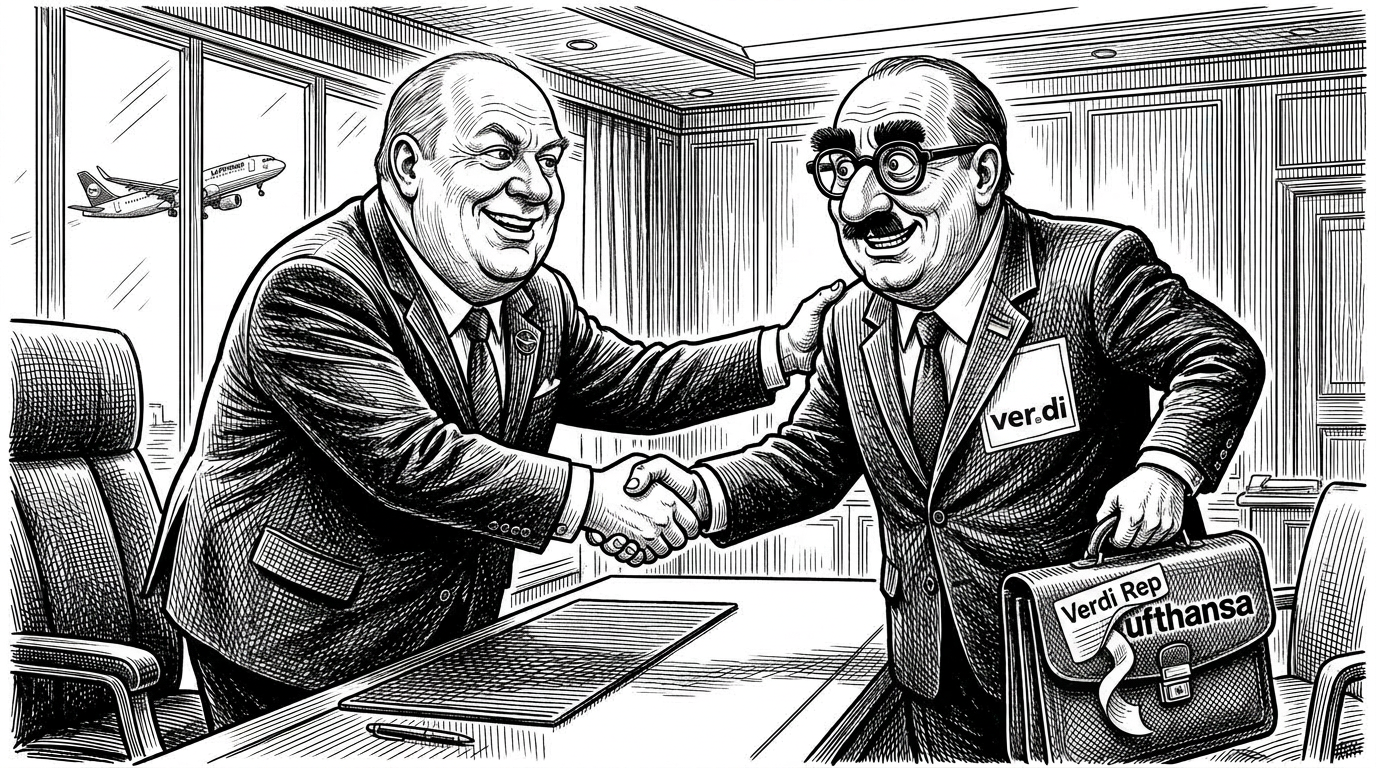
Luftscamsa - Preemptive Deals Install Corporate-Preferred Union
Lufthansa Group has executed a coordinated labor strategy designed to select its own bargaining partners, methodically positioning a more compliant multi-sector union to sideline independent aviation specialist organizations at its newer subsidiaries. This corporate maneuver, which utilizes preemptive collective bargaining agreements, represents a deliberate effort to block the pilots’ union Vereinigung Cockpit and the cabin union UFO. By locking in early contracts with the larger services union Verdi, the executive board has established a legal barrier against specialized employee groups. While management defends these agreements as a means to ensure industrial peace and operational predictability, specialized unions argue that the process represents a form of corporate collusion. The strategy seeks to suppress labor costs and bypass the more stringent working conditions traditionally demanded by experienced flight crews. The rivalry between these organizations has intensified as the carrier expands its cooperation with Verdi beyond its historical ground crew base. Historically, the airline's ground operations were represented by Verdi, while flying personnel relied on specialized independent groups to negotiate sector-specific working conditions. Preemptive Agreements The origins of this labor realignment date back to the launch of Discover Airlines in 2021. The leisure-focused subsidiary was established to expand the group's market share while operating outside the expensive collective bargaining agreements that govern the mainline brand. Flight crews at the new carrier organized rapidly to protect their interests, establishing a works council in late 2022 with strong backing for the specialized unions VC and UFO. To counter this unionization, Discover's management executed a controversial legal maneuver in August 2024. Instead of signing a contract with the unions that actually represented the vast majority of their pilots and cabin crews, the airline's executives signed a surprise first collective agreement with Verdi. At the time, the multi-sector union had almost no membership among Discover’s flying personnel. Independent union representatives said that Lufthansa rushed into closed-door, nocturnal negotiations with Verdi to preemptively lock out the traditional specialty unions. This maneuver successfully established Verdi as the baseline contract holder before specialized organizations could secure their own agreements. The Statutory Shield The mechanism behind this consolidation relies on a specific provision of German labor law known as the Tarifeinheitsgesetz, or the Statutory Uniqueness Principle. Under this regulation, if multiple unions hold conflicting collective bargaining agreements within a single business operation, only the agreement of the union with the largest membership in that specific unit is legally applicable. By concluding an early, highly flexible contract with Verdi, Lufthansa executives established a legal shield against the specialized unions. They knew that VC and UFO could not legally force a membership count under the law without first securing their own collective agreements, which was a step management refused to negotiate. This practice of playing subsidiaries against each other is a central element of the group's broader corporate restructuring. Under the direction of Chief Executive Officer Carsten Spohr, the executive board remains committed to a shareholder mandate to double the group's profit margin to between eight and ten percent by 2030. The aggressive cost-reduction drive is detailed in a recent Pax Sentinel performance review of how [Mr. Spohr prioritizes profit margins over passenger and employee welfare](/en/article/RLdAb1kG_midyear-performance-review-carsten-spohr-prioritizes-margin-over-mission). By standardizing labor agreements under a single, larger union, the company aims to simplify its corporate structure and eliminate costly, sector-specific concessions. The strategic marginalization of specialized unions represents the next logical phase of a long-standing corporate practice, [first detailed during our investigation into how Lufthansa weaponizes subsidiaries against labor](/en/article/gtLjDSYD_how-lufthansa-weaponizes-subsidiaries-against-labor). For over two decades, the airline has repeatedly shut down unionized subsidiaries to replace them with entities operating under lower-cost contracts. Corporate Collusion The strategic positioning of a preferred union matches a broader pattern of corporate collusion designed to neutralize worker resistance. By establishing Verdi as the primary bargaining partner, management has sought to secure a more submissive counterpart at the negotiating table. Specialized crew unions have argued that Verdi, as a massive public services union, lacks the sector-specific focus and expertise required to navigate the complex safety, health and scheduling challenges unique to aviation personnel. They state that the arrangement prioritizes corporate financial targets over crew fatigue limits and passenger safety. The tension has also been compounded by subsequent works council elections on May 29, 2026, where Verdi-affiliated lists secured majorities at Discover Airlines and Lufthansa City Airlines. While some analysts state that this victory represents a democratic shift, specialized union leaders argue that the outcome was heavily influenced by management’s prior promotion of the services union. UFO has specifically alleged that Lufthansa management actively intervened in recruitment by tying certain job security benefits and favorable operational conditions directly to Verdi membership. These actions effectively used corporate resources to marginalize independent representation. Operational Friction The friction generated by these labor maneuvers comes as the airline group faces mounting operational difficulties. The reduction in regional capacity and the transition of crews to newly formed entities contributed to [widespread scheduling failures that grounded hundreds of flights](/en/article/sMJXUtBM_scheduling-failures-ground-hundreds-of-flights) on June 1, leaving thousands of passengers stranded at the Frankfurt and Munich hubs. Ms. Sara Grubisic, the deputy chairperson of UFO and a member of the Lufthansa Group Supervisory Board, said that the company is verifiably operating on the absolute limit of its personnel capacity. Ms. Grubisic said that reducing crew reserves and relying heavily on voluntary shifts compromises the basic stability of scheduled flights. The union has also raised concerns regarding Lufthansa’s new long-haul service concept, operating under the project name "Fox." Ms. Grubisic said that the airline is sending out long-haul flights with reduced cabin crew sizes, which increases the physical workload on flight attendants and compromises safety margins. The struggle to maintain labor standards coincides with aggressive political maneuvers by the airline group. Lufthansa has concurrently [lobbied the German government to restrict strike laws](/en/article/QrS5RjOp_lufthansa-lobbies-to-undermine-german-strike-law) for critical infrastructure sectors, aiming to legislatively insulate its operations from the financial consequences of labor disputes. Furthermore, the carrier is actively trying to protect itself from the financial fallout of its operational decisions by [lobbying European Union regulators to reduce passenger compensation](/en/article/4SL2uE24_lufthansa-lobbies-to-reduce-eu-passenger-compensation). The group has proposed extending delay thresholds and exempting labor disputes from compensation liabilities under Regulation (EC) No 261/2004. Mr. Joachim Vázquez Bürger, the chairperson of UFO, said that pushing established unions out of the collective bargaining process undermines the basic rights of aviation workers. Mr. Vázquez Bürger said that prioritizing short-term labor cost predictability over employee stability will inevitably degrade the premium identity of the Lufthansa brand.