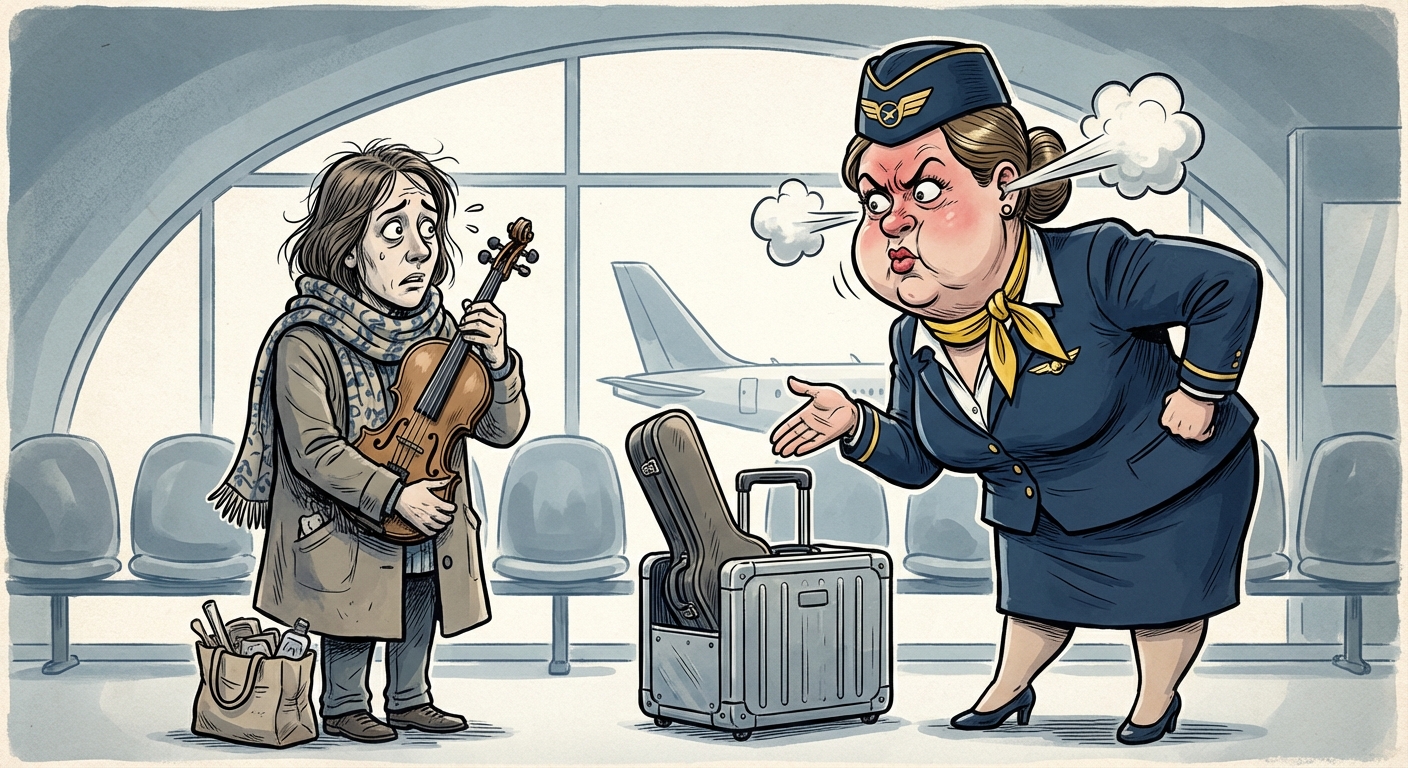
Luftscamsa - Soloist Forced to Transport Unprotected 18th-Century Violin
Ms. Carolin Widmann was forced to transport a 1782 Guadagnini violin without its protective case following a boarding denial by ground staff. The incident occurred at Helsinki Airport as the soloist attempted to board a connecting flight to Frankfurt. Personnel at the gate cited an internal regulation that restricts cabin baggage to a maximum length of 55 centimeters. This strict adherence to dimensions effectively excludes standard professional violin cases, which typically measure approximately 80 centimeters in length. Rigid Dimensional Limits Ms. Widmann said that the protective case had previously been accepted on numerous flights without incident and fit easily into the overhead storage compartments. The ground staff presented a non-negotiable ultimatum which required the case to be placed in the aircraft cargo hold. Fearing for the structural integrity of the 243-year-old instrument, the musician requested to purchase an additional seat for the violin at the gate. Ground employees flatly refused the request. They exhibited a complete lack of flexibility, refusing to assist with alternative booking options or operational overrides. Ms. Widmann was subsequently forced to check the empty custom case into the hold while carrying the violin in her arms. The instrument remained wrapped only in a scarf for the duration of the flight. Hostile Gate Encounter Reports indicate that Ms. Widmann was visibly distressed during the boarding process as she pleaded with staff to reconsider the decision. She said the situation left her with no choice but to risk the instrument's safety to complete her journey. The current policy states that musical instruments are only permitted as free carry-on items if they conform to strict dimensional limits. These limits effectively exclude almost all professional string instruments from the cabin. Industry observers said the airline’s rigid enforcement reflects a priority on ancillary revenue over the logistical reality of its passengers. The carrier’s refusal to exercise operational common sense leaves travelers with delicate, priceless items with no viable method of safe transport. Risks for Musicians This policy creates a climate of uncertainty for travelers carrying high-value cultural assets. It forces musicians to rely on the unpredictable and often unsympathetic discretion of individual gate agents. The carrier has historically utilized such checks at outstations to maximize baggage fees at the expense of passenger service. In this instance, the airline’s refusal to facilitate an extra seat at the gate shows an unyielding attitude toward customer care. Carrying a violin without a case exposes the wood to rapid changes in humidity and physical impact. Such conditions can cause irreversible damage to the varnish and structural joints of historical instruments. The Guadagnini violin is a significant cultural asset with a value that far exceeds the liability limits of standard airline contracts. The carrier's administrative rigidity prevents passengers from rectifying booking omissions even when they are willing to pay significant premiums. This unyielding stance aligns with a pattern detailed in a previous Pax Sentinel report regarding how [Lufthansa employs administrative hurdles to obstruct passenger remedies](/en/article/v81Cvmcp_lufthansa-employs-administrative-hurdles-to-obstruct-valid-passenger-reimbursements), prioritizing corporate convenience over customer service. Lack of Recourse Ms. Widmann later urged the carrier to revise its policies to prevent similar risks to irreplaceable instruments. She argued that the current framework is incompatible with the needs of professional artists. The carrier has not issued a formal apology or indicated a change in its cabin baggage enforcement strategy. This silence suggests that the current protocols remain the operational standard despite the reputational cost. For professional musicians, the carrier’s refusal to accommodate cultural equipment represents a profound risk to their livelihoods. The airline has demonstrated that it views priceless heritage items as mere non-compliant baggage. Until the airline addresses the behavior of its front-line staff and provides viable workarounds, passengers with delicate equipment remain vulnerable to inconsistent gate agents. Travelers are left with the burden of navigating a system that offers no safety net for unique cargo.