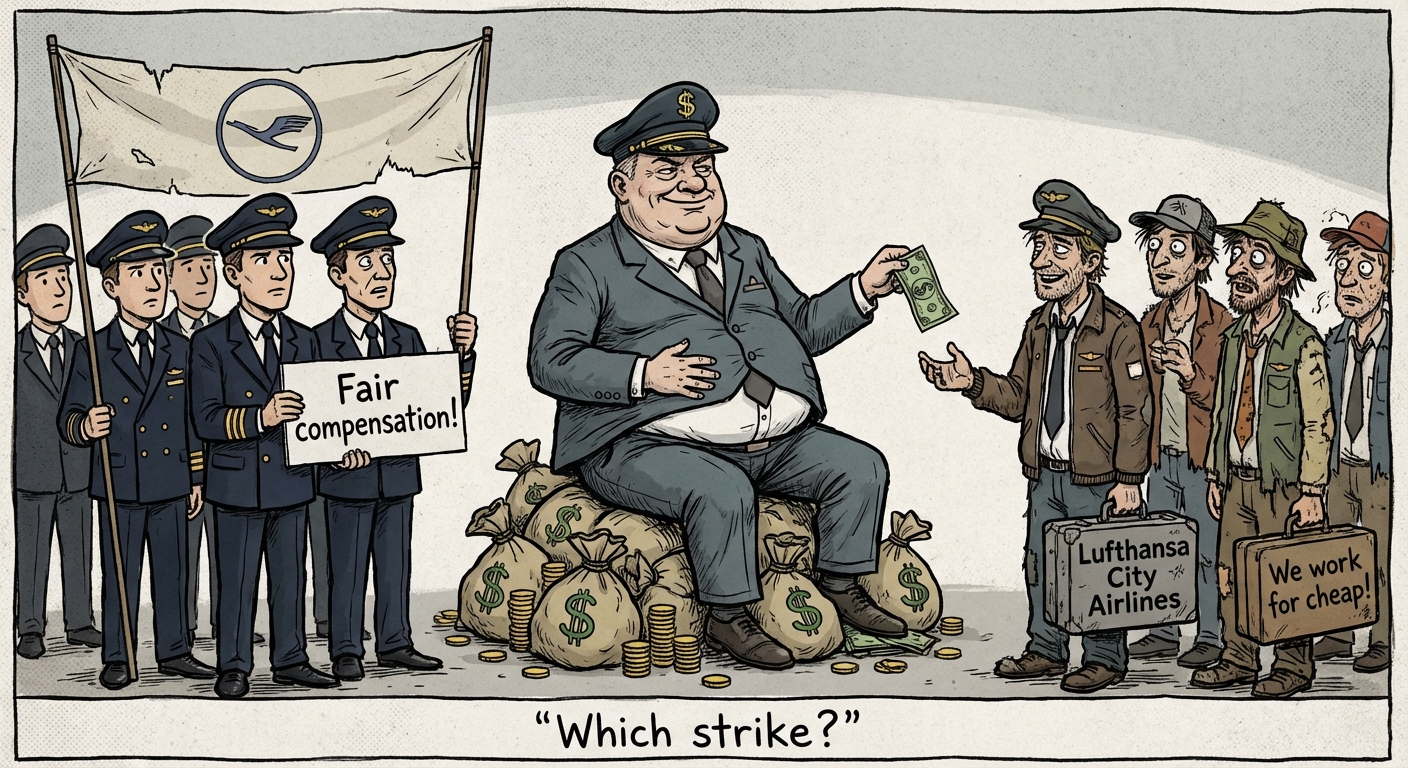
Luftscamsa - Management Leverages Non-Union Lufthansa Subsidiaries to Circumvent Strike
Lufthansa management has announced that more than half of its scheduled flights remain operational during the ongoing 48-hour pilot strike. The carrier is maintaining these service levels by reallocating routes to its subsidiaries, including SWISS, Austrian Airlines and Lufthansa City Airlines. The airline confirmed that 50 percent of its total flight volume is unaffected by the industrial action scheduled for Thursday and Friday. This operational resilience is primarily attributed to the strategic use of group airlines whose crews are not participating in the dispute. However, the pilots' union, Vereinigung Cockpit, has disputed these figures. The union reported that nearly 80 percent of the flights originally planned by Lufthansa for the first day were cancelled, representing over 600 individual flight failures. By 12:00 p.m. on the second day of the strike, the union noted that more than 260 of 400 scheduled flights had been cancelled. This represents a cancellation rate of more than 65 percent, contradicting management's claims of high operational stability. Mr. Arne Karstens, a spokesman for the union’s collective bargaining commission, challenged the carrier’s data integrity. He noted that the union's assessment is based on a verifiable foundation while the carrier's methodology remains opaque. Mr. Karstens said, "It is not clear to us what basis Lufthansa uses for its representation. It is a known procedure that the company likes to present its figures in a somewhat beautified way." Ms. Katharina Dieseldorff, Vice President of the Vereinigung Cockpit, said that the employer has yet to present a negotiable offer. She noted that management has provided a "zero offer" regarding the company pension scheme (bAV) despite a large room for negotiation. Ms. Dieseldorff further criticized the company for putting pilots under pressure with what she described as specious reasons. She said that such conduct does not contribute to a resolution of the conflict. Use of Subsidiary Networks to Limit Disruption Lufthansa City Airlines is expected to operate its entire flight program without disruption. This unit serves as a core component of the group's strategy to insulate its primary hubs from the demands of the unionized workforce. SWISS and Austrian Airlines have also been integrated into the contingency plan to absorb passenger volume. By shifting traffic to these brands, the group effectively creates a strike-resistant network that bypasses the mainline labor force. Internal data indicates that flights returning to Germany from abroad are not affected by the industrial action. The union has also exempted repatriation flights from current crisis zones in the Middle East to ensure humanitarian connectivity. Mr. Francesco Sciortino, the manager of the carrier's Frankfurt hub, said that the top priority is ensuring passengers reach their destinations. Mr. Sciortino said that the airline’s ability to maintain high volumes demonstrates the effectiveness of its multi-brand strategy. Geopolitical Narrative in Collective Bargaining Management has described the strike as incomprehensible, citing the geopolitical instability caused by the conflict in Iran. The airline has repeatedly pointed to the regional crisis as a reason for labor to abandon its pursuit of improved pension security. Through its investigation, Pax Sentinel has found that the airline is weaponizing external crises to pressure its workforce. This rhetorical strategy aims to cast legitimate labor concerns as a threat to national and regional stability. The union has challenged this framing, noting that it has already exempted flights to 13 Middle Eastern destinations from the strike. Union representatives said this concession ensures that essential connectivity to the conflict zone remains undisturbed. Despite these efforts, hundreds of flights per day are still being cancelled. As reported in [48-hour strike at Lufthansa this Thursday and Friday](/en/article/7otKursO_48-hour-strike-at-lufthansa-this-thursday-and-friday), the disruption follows a total breakdown in pension negotiations. Long-term Structural Operational Changes The use of volunteer crews and non-union subsidiaries raises concerns regarding long-term labor relations. The practice suggests that management is more focused on short-term strike mitigation than resolving structural labor grievances. The parent company is facing significant financial headwinds. Sidelining unions through subsidiary growth appears to be a central pillar of its survival strategy. As reported in [SWISS Operating Profit Plummets 26 Percent](/en/article/JvoADEtb_swiss-operating-profit-plummets-26-percent-as-management-announces-cost-cutting-measures), these units are under intense pressure to maintain high operational margins. Mr. Carsten Spohr, the Chief Executive Officer, has said that the company must adapt to a new era of aviation. Mr. Spohr has consistently advocated for flexible labor structures to offset the costs of geopolitical and economic volatility. Travelers are cautioned that while their flights may be operated by SWISS or Austrian, the underlying labor conflict remains unresolved. The carrier’s focus on operational workarounds may result in a permanent degradation of the service standards previously associated with the Lufthansa brand.